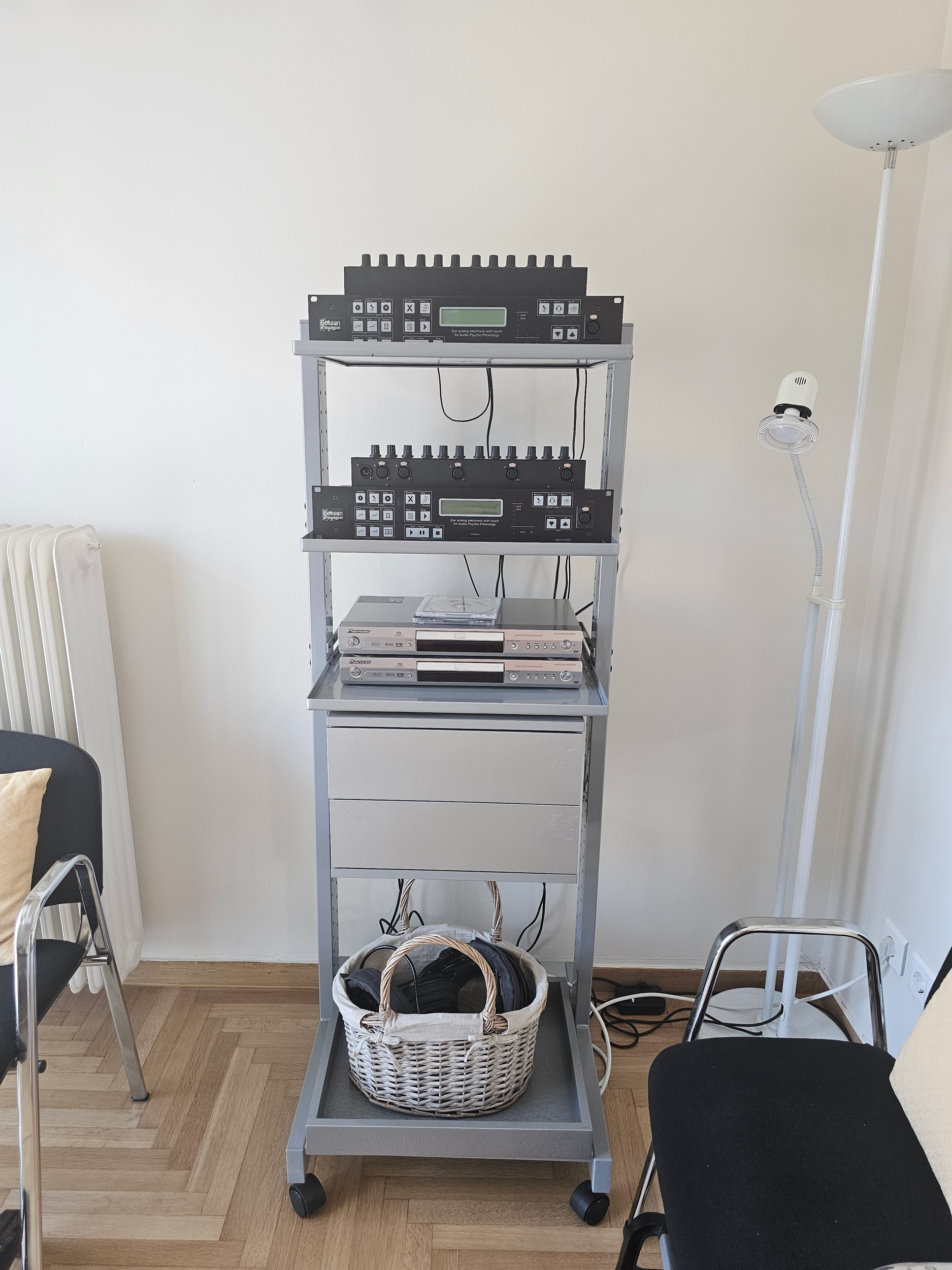
Audio-Psycho-Phonology is an interdisciplinary approach to auditory retraining, which aims to improve the individual's ability to listen, process and decode auditory stimuli.


The approach was developed by Professor Alfred Tomatis, Otolaryngologist and Psychophysiologist, and is based on the close relationship between hearing, psyche, phonation and language.
The method's neuroacoustic effect on hearing and phonation, known as the Tomatis Effect, was presented to the French Academy of Sciences in 1957. According to Tomatis, there is a direct connection between hearing and phonation: “we sing and speak with our ears.”
The method can be applied to auditory processing disorders, specific learning disabilities, language disorders, Attention Deficit/Hyperactivity Disorder (ADHD), emotional regulation difficulties, etc.
Sound therapy can function either as a stand-alone intervention or as a complement to other therapeutic approaches, contributing to the creation of the appropriate neurosensory conditions for optimizing the therapeutic process.
— 01
The pregnancy program offers neurosensory support for the development of the fetus through the use of specially filtered music and the maternal voice.
— 02
The voice improvement program is primarily designed for professional voice users and aims to improve the auditory perception of affected frequencies, with the goal of improving the quality and harmonic richness of the voice, to the extent possible.
— 03
Foreign language programs aim to facilitate the learning of a new language through auditory sensitization to the characteristic (“preferred”) frequencies of that particular language.
Sound therapy is carried out through the Electronic Ear, according to the principles of the Tomatis Effect. Sessions are conducted either at the Center or at home, using portable Electronic Ears and the necessary accompanying equipment. The Electronic Ears we use have been manufactured according to the specifications set by Professor Alfred Tomatis and have evolved technologically since he himself developed the first Electronic Ear, in the 1950s. Despite technological developments, they retain certain critical technical characteristics that are considered essential for the effective implementation of auditory retraining:
• Fully analog operation. An analog Electronic Ear has technical features that allow the transmission of a wide frequency range and the real-time switching of channels (gating), with dynamic adaptation to changes in the musical stimulus or voice. • Personalized programming. All sound therapy parameters are adapted to the specific needs of each individual, allowing the implementation of a fully personalized therapeutic program.